
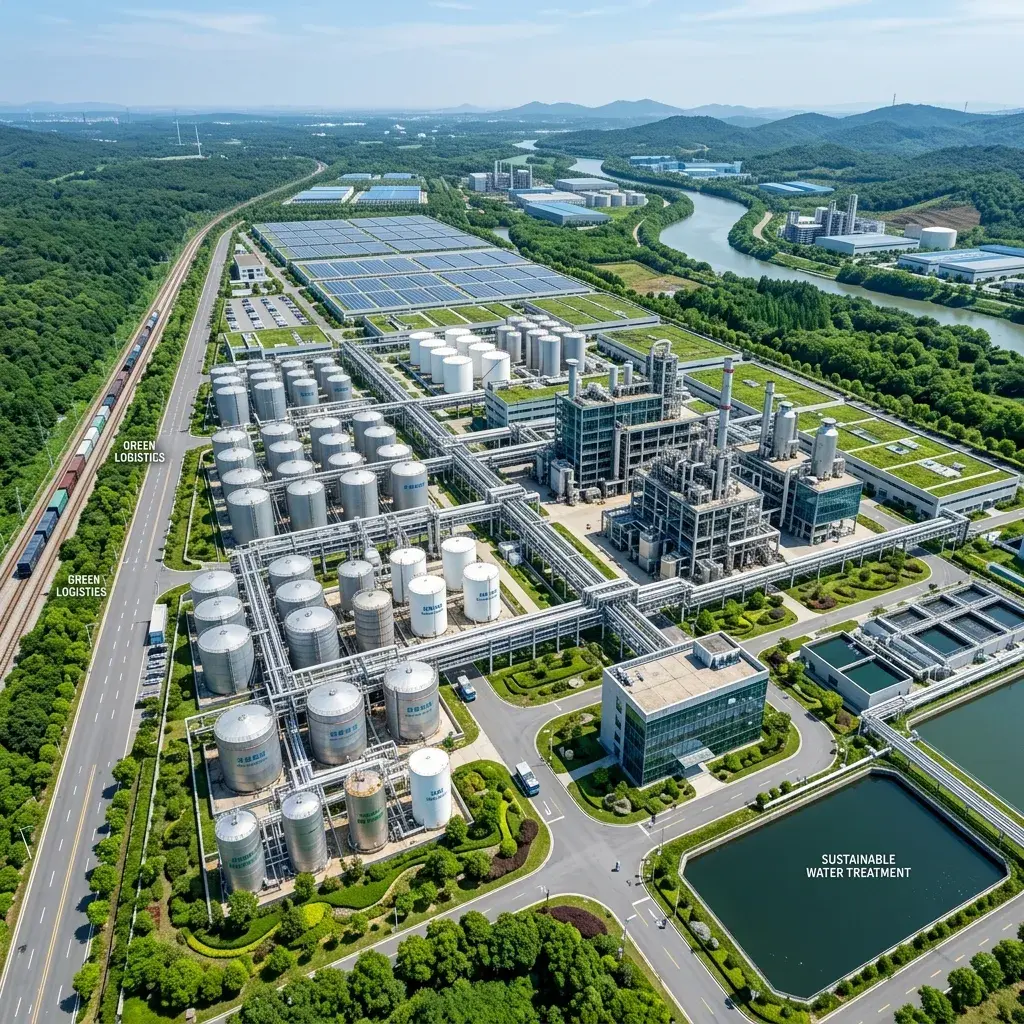
BOPET Film Trim Chemical Recycling: Upgrading from "Downstream Recyclers" to "In-Line Optical-Grade Regeneration"
BOPET biaxially-oriented polyester film plants generate 3-8% trim waste annually, historically sold to recyclers at undervalued prices. This article details the process, economics and PCF data of in-line chemical-recycling DMT plants, with build guides for 500 / 2,000 / 5,000 t/y scales.
BOPET biaxially-oriented polyester film processes generate trim, ignition and broken-film waste continuously, totalling 3-8% of total output annually. A 50 kt/y BOPET line means 1,500-4,000 t/y waste polyester to dispose of — historically sold to downstream recyclers at ¥4,800-5,200/t. This is severe value under-realisation: regenerated to polyester-grade DMT for in-line reuse, equivalent feedstock value reaches ¥8,500-9,200/t. This article details the process, economics and carbon footprint data of in-line chemical recycling.
1. Why BOPET Plants Are Especially Suited to Chemical Recycling
Mechanical recycling limitation: BOPET trim through melt-extrusion mechanical recycling suffers thermal history accumulation, IV value drop, b-value rise — unsuitable for in-line reuse to optical-grade BOPET (which requires raw material b-value ≤0.5, purity ≥99.95%). Mechanical recycling at best feeds low-end textile or packaging downstream.
Chemical-recycling (methanolysis) natural fit: BOPET trim is single-component (>99% PET), clean (no bottle-grade contamination), IV-controllable — ideal feedstock. ResourceCycle measured data: BOPET trim post-pretreatment shows ≥99.3% methanolysis conversion (vs ≥98% for bottle-grade PET); optical-grade DMT color controllable to ≤3 APHA, b-value ≤0.3.
Logistics advantage: chemical-recycling plant deployable physically adjacent to BOPET line, logistics radius ≤50 m (vs ≥80 km for external recycler), 99% logistics carbon reduction, ¥200-300/t logistics cost savings.
2. In-Line Regeneration Process Design
ResourceCycle's BOPET in-line solution comprises 5 process units:
Pretreatment: shredder → vibrating screen → rotary drier; removes tension-roller surface residue, dust; moisture ≤0.3%.
Reactor train: 2 × 2 m³ twin-reactor in series (500 t/y) or 3 × 5 m³ triple-reactor (2,000 t/y+); 155-170 °C / 0.1-0.3 MPa; Zn-Mn binary catalyst; 90-120 min residence.
Distillation: 4-stage tray column separates methanol / EG / oligomers; methanol ≥99.5% recycled to reactor.
Crystallisation: gradient cooling 110→55 °C in 3 stages; centrifuge + drying for DMT crystal (D₅₀ 250-400 μm).
Optical-grade deep refining: 4-stage distillation + activated carbon + molecular sieve; DMT b-value ≤0.3, color ≤3 APHA, purity ≥99.95%.
Footprint 280-450 m²; 4 × 20 ft container modules; site assembly ≤5 days; non-stop retrofit feasible.
3. Economic Analysis (500 t/y Skid Case)
ResourceCycle's 500 t/y mobile skid delivered to a South China BOPET client — actual data Jan-Sep 2025:
Capex: ¥9M (skid equipment + installation + utilities), ¥18,000/t capacity (40% lower than fixed unit).
Trim waste processed: 500 t/y (100% in-plant consumption).
DMT output: 450 t/y (optical-grade, b-value ≤0.3).
Feedstock value uplift: trim from external sale ¥4,800/t to in-line feedstock ¥8,500/t, +¥3,700/t per ton.
Plus raw material substitution savings (no external optical-grade purchases): annual new economic benefit ¥2.2M.
Static payback: 4.2 years (incl. skid equipment + installation).
4. PCF Data & Brand Customer Compliance Value
ResourceCycle + SGS completed full-chain ISO 14067 PCF verification: BOPET trim → chemical recycling → optical-grade DMT → BOPET reuse. Client BOPET unit product carbon footprint fell 18% (PCF from baseline 4.2 t CO₂e/t to 3.45 t CO₂e/t).
PCF report delivered to client BOPET downstream brand customers (a display panel manufacturer, an EV manufacturer) for their Scope 3 disclosure. The BOPET client thereby entered two brands' 2026 green procurement candidate list, with 8,000 t/y new BOPET order intent secured.
ISCC PLUS mass-balance: BOPET client labels "recycled content X%" for brand customer 2027 compliance list (recycled material content ≥25%).
5. Build Guide for 500 / 2,000 / 5,000 t/y Scales
500 t/y · Mobile skid: 280 m² footprint, ¥9M capex, 4 containers transport, 5-day assembly, 4.2 yr payback. Suits 20-50 kt/y BOPET single line with full internal trim consumption.
2,000 t/y · Fixed skid: 800 m² footprint, ¥32M capex, 12 containers transport, 14-day assembly, 3.4 yr payback. Suits 80-150 kt/y BOPET park, internal consumption + partial sale to affiliates.
5,000 t/y · Modular skid: 2,000 m² footprint, ¥85M capex, 3.0-3.4 yr payback. Suits BOPET park + multi-line + regional recycling service to nearby polyester film plants.
- 01BOPET trim chemical recycling delivers ¥3,000-4,000/t value uplift vs external recycler sale.
- 02Optical-grade DMT in-line reuse cuts BOPET PCF 18%; passes brand customer green-procurement compliance.
- 03Skid solution payback 3.0-4.2 years; 4 containers transport; 5-14 day on-site assembly; non-stop retrofit feasible.
- 04ISCC PLUS + ISO 14067 dual certification is the key to BOPET customer entry into brand green procurement.