
DMT and Ethylene Glycol Co-Supply: How Dimethyl Terephthalate Manufacturers Serve the Polyester Value Chain
ResourceCycle's 5,000-ton/year DMT and 1,600-ton/year Ethylene Glycol (EG) supply capability supports PBT, PET, polyester fiber, antifreeze and resin customers evaluating integrated raw material suppliers.
TL;DR
- ResourceCycle's 5,000-ton/year DMT and 1,600-ton/year Ethylene Glycol (EG) supply capability supports PBT, PET, polyester fiber, antifreeze and resin customers evaluating integrated raw material suppliers.
- Keywords: DMT and EG co-production · ethylene glycol supplier · polyester value chain · methanol recovery · integrated monomer supply
DMT and Ethylene Glycol from One Source
In the polyester value chain, DMT and ethylene glycol (EG) usually appear together in a customer's raw material basket. ResourceCycle's Huanggang base is designed for 5,000 tonnes of DMT and 1,600 tonnes of ethylene glycol a year — which allows a single supply conversation to cover both for PBT, PET, polyester fibre, antifreeze and resin customers.
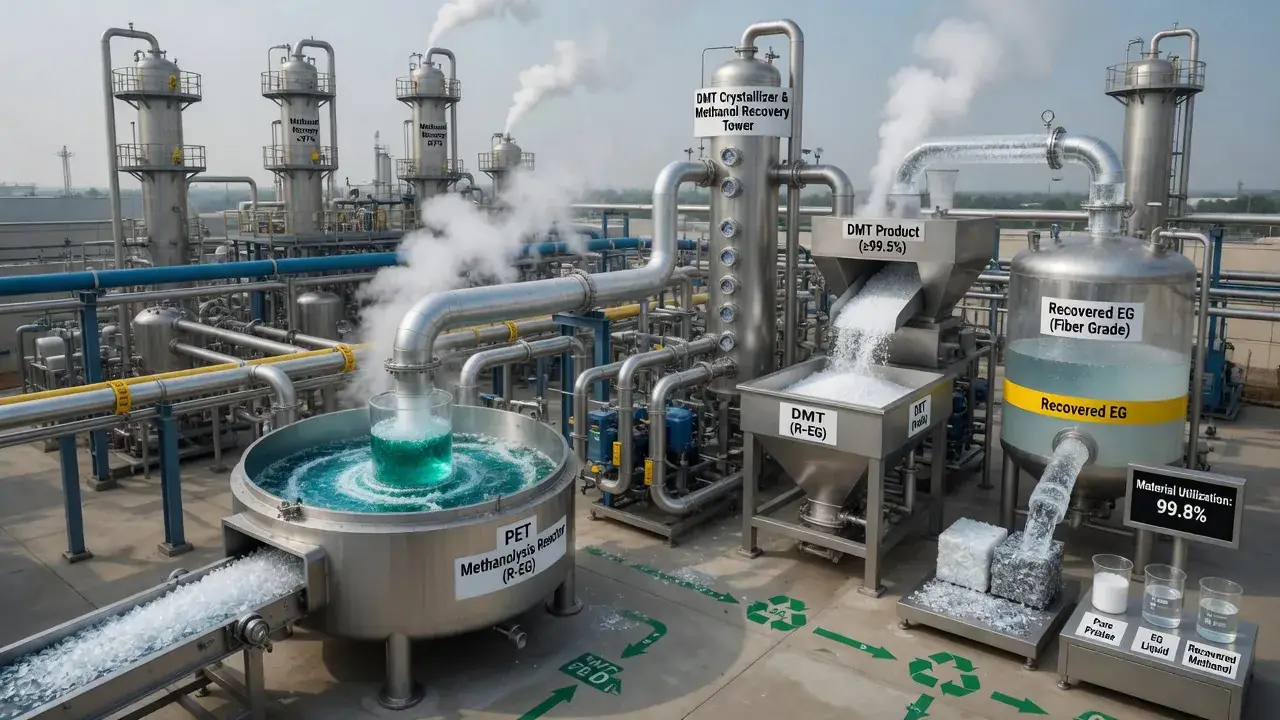
The methanolysis reaction
PET + 2 CH₃OH → DMT + EG
| Output | Theoretical yield | Per tonne of PET |
|---|---|---|
| DMT | 0.86 tonnes | per tonne PET |
| EG | 0.31 tonnes | per tonne PET |
| Material utilisation | close to 100% | versus 40–60% for the pyrolysis route |
Ethylene glycol specification and market
Downstream applications for EG
- Antifreeze — automotive and building systems
- Polyester feedstock — resynthesis into PET
- Unsaturated polyester resin — FRP and composite materials
- Vinyl ester coatings — industrial protective coatings
| Market indicator | Position |
|---|---|
| Market price | RMB 4,500–5,500 per tonne |
| Trend | The spread between recycled EG and petrochemical EG continues to narrow, strengthening competitiveness and market acceptance |
Methanol recovery and recycling
Methanol recovery runs at ≥97%. Recovered methanol is separated in the distillation column and returned to the methanolysis reactor:
methanolysis reaction → distillation separation → 97% recovery → returned to process
Why a co-production supplier is worth evaluating
- Coordinated supply: DMT and EG requirements can be discussed with one supplier, cutting procurement overhead.
- Consistent documentation: COA, MSDS, batch records and supplier qualification files are managed as one set.
- Stable delivery planning: suits annual framework purchasing and multi-plant stocking coordination.
- Application support: a supplier producing both understands how DMT and EG specifications interact in a polyester customer's process.
Frequently Asked Questions
Q1: Why can DMT and EG be co-produced?
The chemical methanolysis process uses waste PET and methanol as feedstock: PET + 2 CH₃OH → DMT + EG. In theory, every tonne of DMT produced also yields 0.32 tonnes of EG. ResourceCycle's actual capacity ratio is 5,000 t DMT to 1,600 t EG.
Q2: What is the commercial value of co-produced supply?
It lets customers source two polyester monomers from a single origin — lowering logistics cost, simplifying supplier management, and improving ESG consistency because both sit inside the same product carbon footprint system. That matters most to PET resin and polyester fibre producers who need both.
Q3: How does co-produced EG compare with conventional ethylene-based EG?
Purity ≥99.9%, colour ≤5 APHA, moisture ≤0.1%, aldehydes ≤10 ppm — equivalent to virgin ethylene-based EG, and usable directly in bottle-grade and fibre-grade PET resin synthesis.
Q4: Can co-produced EG be bought on its own?
Yes. It is sold independently into PET, polyester fibre, automotive antifreeze, unsaturated polyester resin (UPR) and polyether polyol applications. Minimum order is 1 tonne, with steel drum, IBC and ISO tank packaging available.
Q5: How do I purchase DMT and EG together?
Send the ResourceCycle commercial team the specification for each, your annual volume and destination port. A co-production framework agreement can then be structured with combined pricing, aligned lead times and a single set of COA, MSDS and carbon footprint documentation.
Related Reading
- Dimethyl Terephthalate (DMT, CAS 120-61-6) — specifications, MSDS / COA
- Ethylene Glycol (EG / MEG, CAS 107-21-1) — specifications, MSDS / COA
- Chemical methanolysis DMT process and core technology
- DMT / EG market outlook and brand recycled-plastic commitments
- Policy: chemical recycling as a strategic emerging industry
- Case studies: Zhejiang University joint research centre and the Huanggang project
- Contact sales — DMT quotation, samples, COA requests
About ResourceCycle
Ruisaike (Hangzhou) New Materials Co., Ltd. is a chemical-process manufacturer of DMT and ethylene glycol. Annual capacity is 5,000 tonnes of DMT plus 1,600 tonnes of ethylene glycol, at purity ≥99.9% — meeting polyester-grade virgin material standards. The company operates a joint research centre with Zhejiang University, holds 12 core patents, and is certified to ISO 14001 and ISO 9001. Products serve PBT, PETG, PCTG, PET resin, polyester fibre, polyester coatings, automotive antifreeze and unsaturated polyester resin. Domestic road freight and sea export are both supported (EXW / FOB / CIF / DAP), with a 1-tonne minimum order, 7–30 day lead times, custom COA, sample requests and ESG documentation support.
Related articles
 01Technology
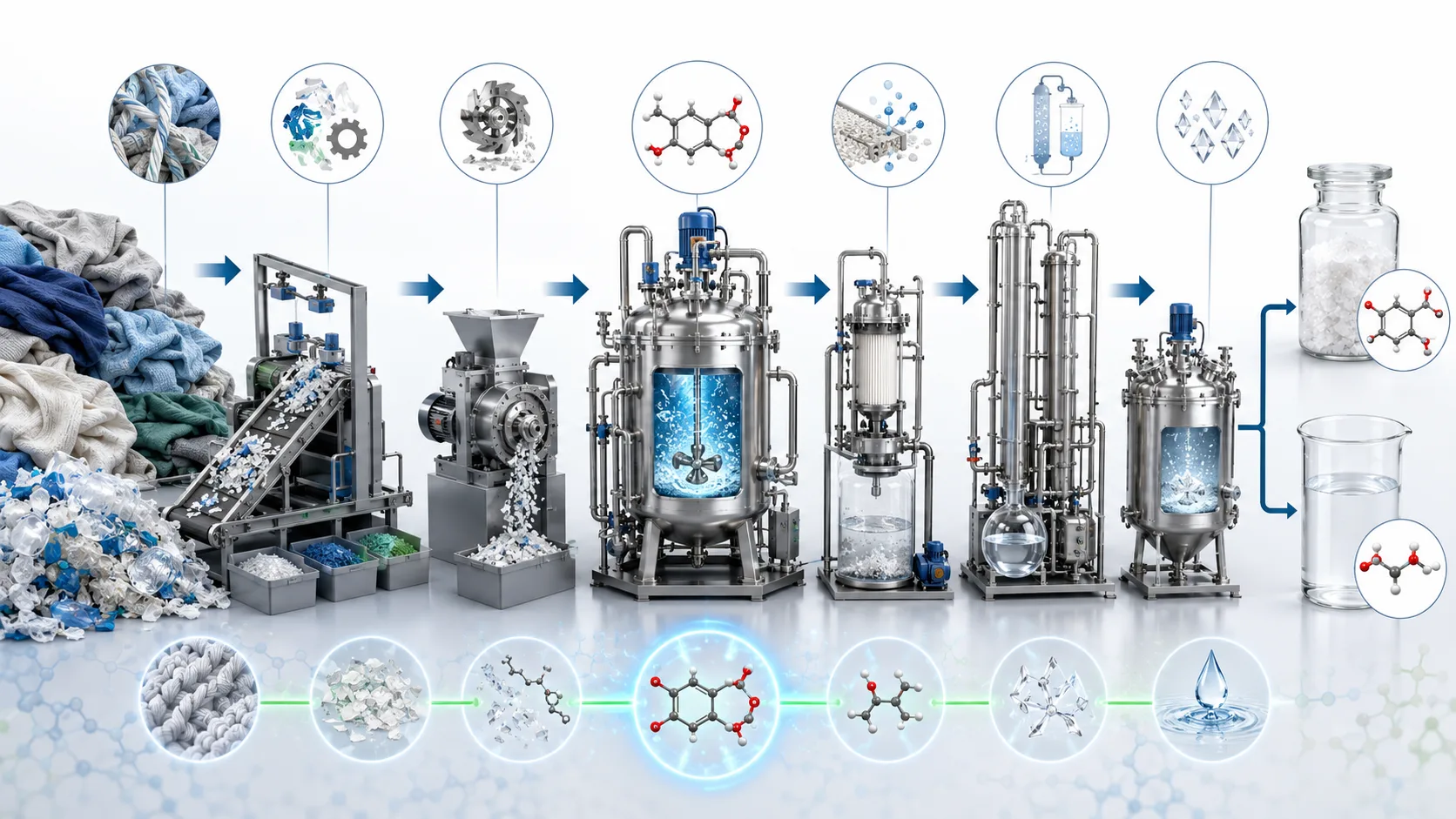
Chemical Recycling of Polyester Fiber Waste: From Waste Polyester to High-Purity DMT and Ethylene Glycol
ResourceCycle explains the four-step chemical recycling process for polyester fiber (polyester textile) waste — pre-treatment, methanolysis depolymerization, DMT and ethylene glycol separation — producing polyester-grade raw materials with purity ≥99.9% from discarded textiles.
Read more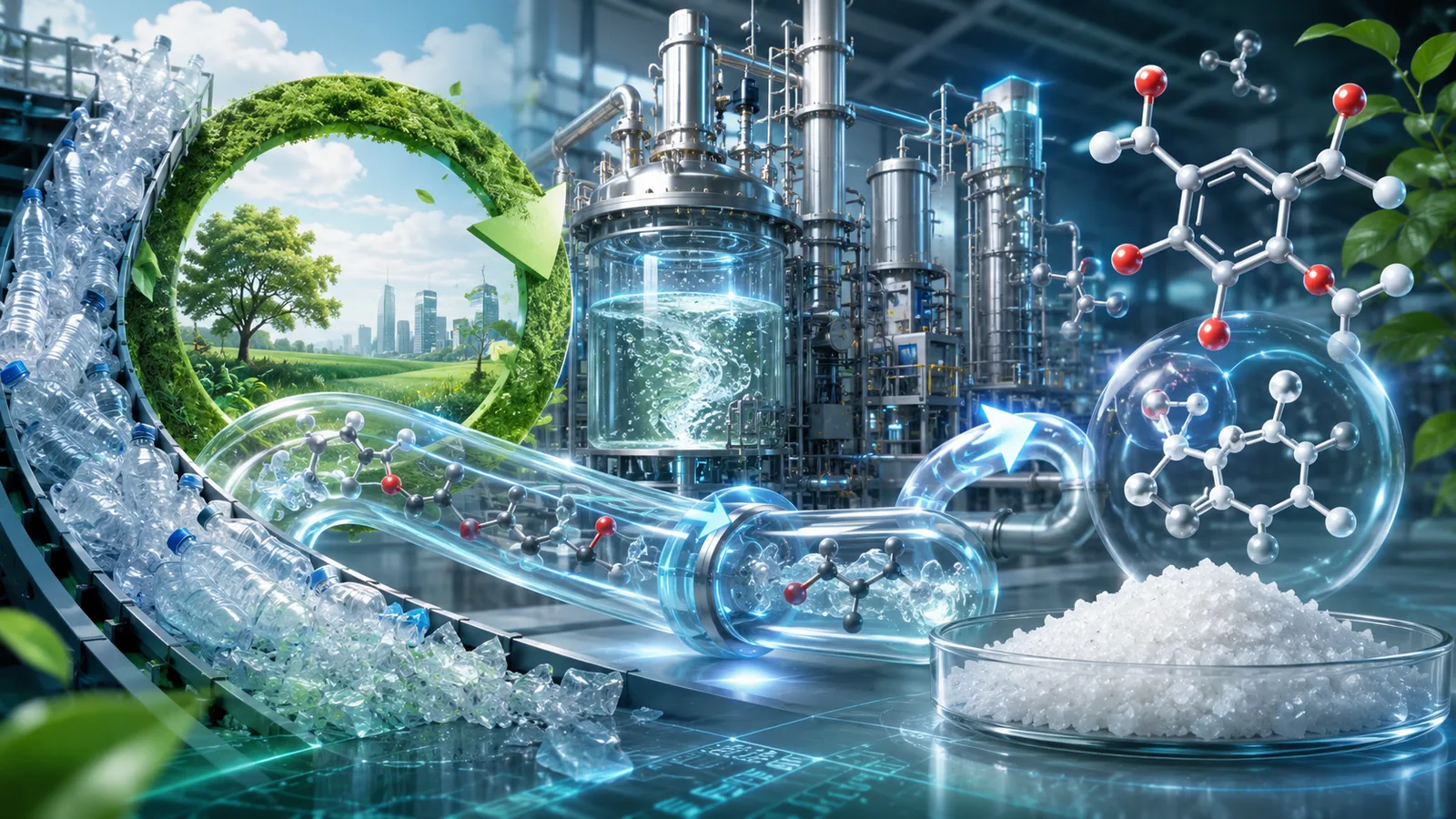 02Technology
Low-Temperature Atmospheric Methanolysis of PET to Polymer-Grade DMT: ResourceCycle's New-Quality-Productivity Process Breakthrough
ResourceCycle and the Zhejiang University Green Carbon Joint Research Center have developed a disruptive process that completes PET chemical depolymerisation at 64.5 °C atmospheric reflux — achieving 99.2% PET conversion, 99.5% DMT selectivity, 99.75% product purity, 60%+ capex reduction, 45-50% energy savings, with kiloton-per-year commercial operation.
Read more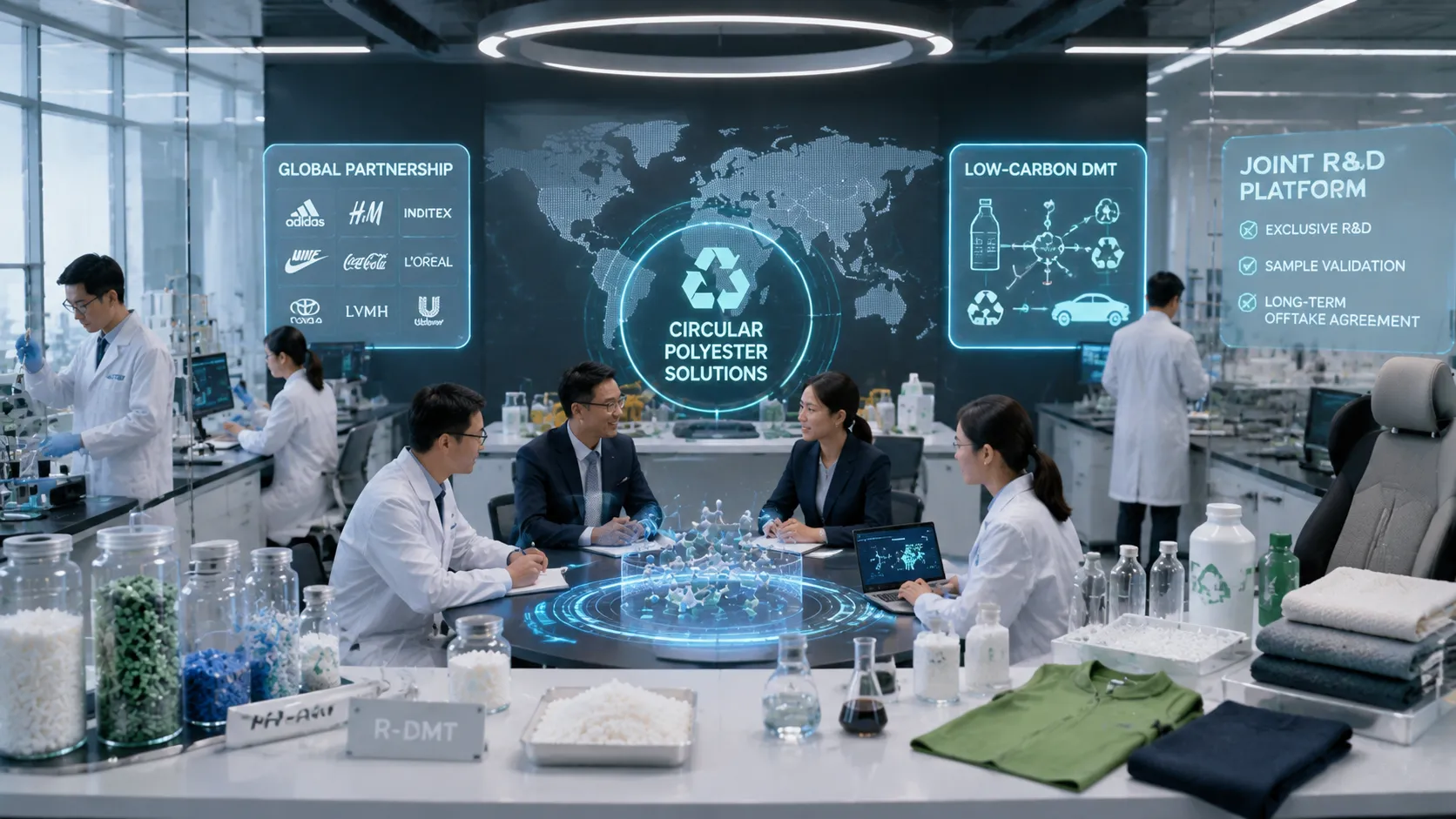 03Technology
ResourceCycle as a Low-Carbon DMT Co-Development Platform for Global Closed-Loop Polyester Partnerships
Global brands are moving material decisions upstream to the polyester monomer level. With high-purity DMT production, methanolysis R&D and closed-loop material platform capabilities, ResourceCycle is positioned for exclusive joint development programs and long-term pre-purchase agreements.
Read more