
High-Purity DMT Specifications: Dimethyl Terephthalate Purity, Color, Acid Value and COA Review Points
A practical guide to polyester-grade DMT specifications including purity ≥99.9%, color, acid value, ash, iron content, COA/MSDS documents and application matching for PBT, PET and PETG customers.
TL;DR
- A practical guide to polyester-grade DMT specifications including purity ≥99.9%, color, acid value, ash, iron content, COA/MSDS documents and application matching for PBT, PET and PETG customers.
- Keywords: high-purity DMT specifications · DMT COA · DMT MSDS · polyester-grade DMT · DMT acid value
High-Purity DMT: The Specification Behind the Polyester
Dimethyl Terephthalate (DMT) is a primary feedstock for PBT, PET, PETG, PCTG, polyester fibre and coating resins. Whether a given lot qualifies as polyester-grade is not settled by purity alone — colour, acid value, ash, iron content, physical form and the completeness of the COA/MSDS package all belong in the assessment.
Quality highlights
| Indicator | ResourceCycle DMT | Note |
|---|---|---|
| Purity | ≥99.9% | Exceeds premium-grade standard |
| Colour (Hazen) | ≤8 | Against a ≤10 standard |
| Heavy metal residue | Not detected | SGS certified |
Specification comparison
| Test item | Premium-grade standard | ResourceCycle DMT | Status |
|---|---|---|---|
| Purity | ≥99.5% | ≥99.9% | Exceeds |
| Acid value | ≤0.05 mg KOH/g | ≤0.03 mg KOH/g | Exceeds |
| Colour (Hazen) | ≤10 | ≤8 | Exceeds |
| Heavy metal residue | Compliant with GB standard | SGS certified | Certified |
Primary applications
- Polyester fibre feedstock — high-purity DMT supports polymerisation stability, colour control and downstream fibre quality.
- PET film and packaging — DMT feeds PET film and PETG/PCTG copolyester applications, where clarity, colour and impurity control requirements are stricter.
- Engineering plastics — DMT is a key input to PBT (polybutylene terephthalate), serving automotive electronics and electrical insulation.
Cost position
- With crude above USD 70 per barrel, recycled DMT runs 15–20% below the petrochemical route on cost
- As carbon allowance prices rise, the green premium on R-DMT becomes more pronounced
- Chinese demand for recycled DMT is projected to exceed 200,000 tonnes per year by 2026
- Addressable market potential runs to the tens of billions of RMB
How to review a DMT COA
When purchasing DMT, examine the COA for purity, melting point, acid value, colour, ash, iron content, moisture and the test methods used — then confirm against your specific application whether those figures actually satisfy your polymerisation requirements. ResourceCycle can provide DMT samples, COA/MSDS documentation and volume supply discussion matched to your application.
Frequently Asked Questions
Q1: What are the core specifications for polyester-grade DMT?
Purity ≥99.9% (GC), colour ≤5 APHA, acid value ≤0.01 mg KOH/g, moisture ≤0.1% (Karl Fischer), ash ≤0.001%, iron ≤0.5 ppm, melting point 140–142 °C. All of these exceed the requirements of GB/T 1668.
Q2: What should a DMT COA contain?
A complete COA carries: batch number, production date, purity (GC%), colour (APHA), acid value, moisture, ash, iron content, melting point, appearance, shelf life, test methods and standards, issuing signature, and third-party laboratory stamp. ResourceCycle issues a COA for every batch.
Q3: What must a DMT MSDS include?
Sixteen sections: chemical identification, hazard summary, composition information, first-aid measures, fire-fighting measures, accidental release, handling and storage, exposure controls, physical and chemical properties, stability and reactivity, toxicological and ecological information, disposal, transport, regulatory information, and other information.
Q4: Do PBT and PETG require different DMT specifications?
Yes. PBT is more sensitive to viscosity and acid value, requiring acid value ≤0.01. PETG and PCTG high-clarity applications are stricter on colour, requiring ≤5 APHA. ResourceCycle can tailor the COA test panel to the downstream application.
Q5: How should a buyer assess a DMT supplier's quality delivery capability?
Check whether purity, colour and acid value meet specification; whether the COA is third-party tested; whether the MSDS is complete; batch-to-batch consistency (RSD); whether samples are offered for qualification; whether ISO 14001 / 9001 system audits are supported; and whether carbon footprint and ESG documentation can be supplied.
Related Reading
- Dimethyl Terephthalate (DMT, CAS 120-61-6) — specifications, MSDS / COA
- Ethylene Glycol (EG / MEG, CAS 107-21-1) — specifications, MSDS / COA
- Chemical methanolysis DMT process and core technology
- DMT / EG market outlook and brand recycled-plastic commitments
- Policy: chemical recycling as a strategic emerging industry
- Case studies: Zhejiang University joint research centre and the Huanggang project
- Contact sales — DMT quotation, samples, COA requests
About ResourceCycle
Ruisaike (Hangzhou) New Materials Co., Ltd. is a chemical-process manufacturer of DMT and ethylene glycol. Annual capacity is 5,000 tonnes of DMT plus 1,600 tonnes of ethylene glycol, at purity ≥99.9% — meeting polyester-grade virgin material standards. The company operates a joint research centre with Zhejiang University, holds 12 core patents, and is certified to ISO 14001 and ISO 9001. Products serve PBT, PETG, PCTG, PET resin, polyester fibre, polyester coatings, automotive antifreeze and unsaturated polyester resin. Domestic road freight and sea export are both supported (EXW / FOB / CIF / DAP), with a 1-tonne minimum order, 7–30 day lead times, custom COA, sample requests and ESG documentation support.
Related articles
 01Technology
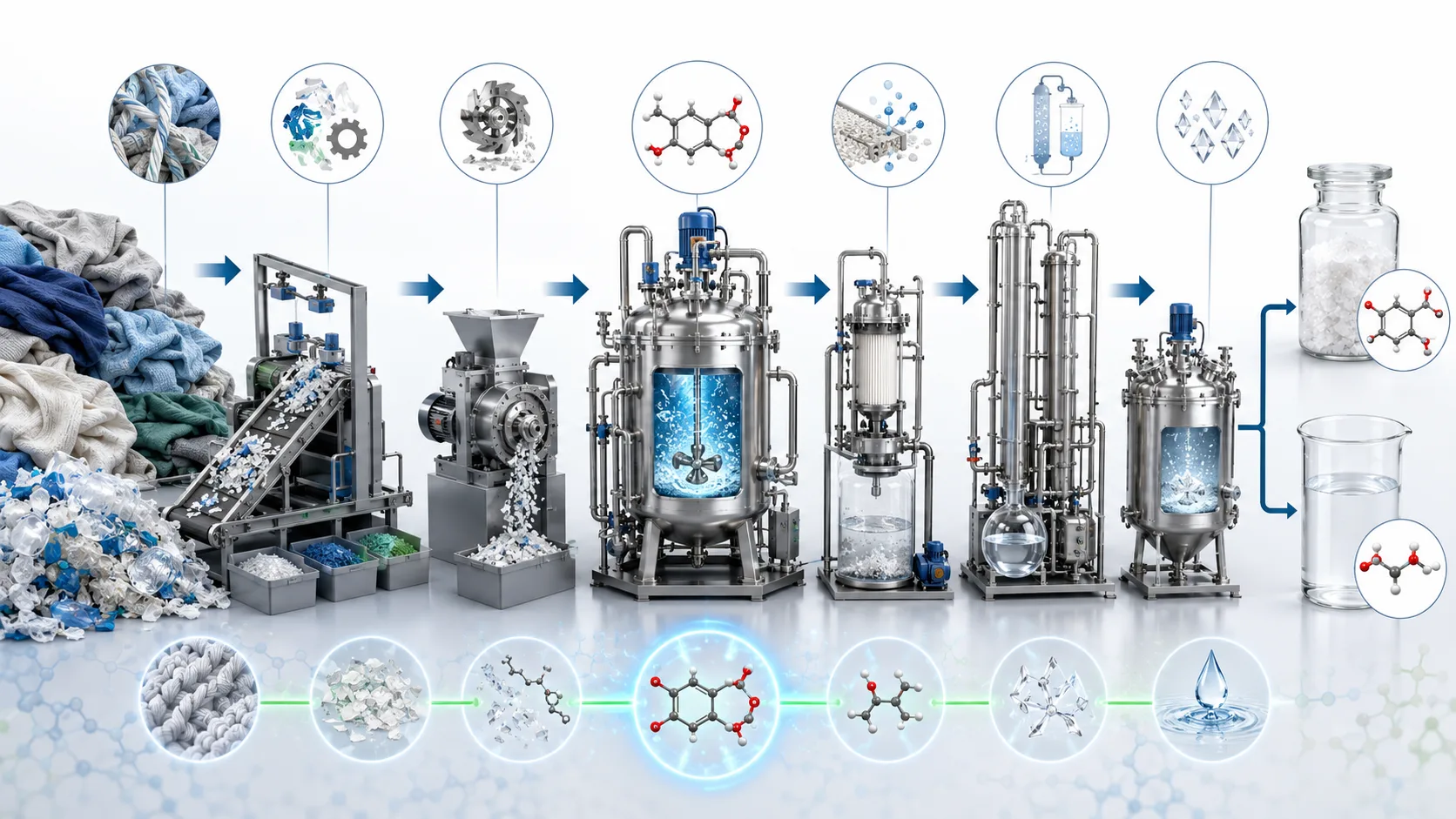
Chemical Recycling of Polyester Fiber Waste: From Waste Polyester to High-Purity DMT and Ethylene Glycol
ResourceCycle explains the four-step chemical recycling process for polyester fiber (polyester textile) waste — pre-treatment, methanolysis depolymerization, DMT and ethylene glycol separation — producing polyester-grade raw materials with purity ≥99.9% from discarded textiles.
Read more 02Technology
Low-Temperature Atmospheric Methanolysis of PET to Polymer-Grade DMT: ResourceCycle's New-Quality-Productivity Process Breakthrough
ResourceCycle and the Zhejiang University Green Carbon Joint Research Center have developed a disruptive process that completes PET chemical depolymerisation at 64.5 °C atmospheric reflux — achieving 99.2% PET conversion, 99.5% DMT selectivity, 99.75% product purity, 60%+ capex reduction, 45-50% energy savings, with kiloton-per-year commercial operation.
Read more 03Technology
ResourceCycle as a Low-Carbon DMT Co-Development Platform for Global Closed-Loop Polyester Partnerships
Global brands are moving material decisions upstream to the polyester monomer level. With high-purity DMT production, methanolysis R&D and closed-loop material platform capabilities, ResourceCycle is positioned for exclusive joint development programs and long-term pre-purchase agreements.
Read more