
Four-Step DMT Quality Control: Raw Material Screening, Decolorization, Precision Drying and COA Batch Management
High-purity DMT quality depends on raw material screening, decolorization, drying control and batch testing. Learn how Dimethyl Terephthalate suppliers stabilize purity, color, acid value and COA delivery.
TL;DR
- High-purity DMT quality depends on raw material screening, decolorization, drying control and batch testing. Learn how Dimethyl Terephthalate suppliers stabilize purity, color, acid value and COA delivery.
- Keywords: DMT quality control · DMT COA · decolorization · batch consistency · polyester-grade DMT
Quality Control Is What Makes DMT Predictable
For downstream customers, the stability of high-purity DMT matters more than any single test result. A lot can hit 99.9% purity and still cause trouble: if colour, acid value, moisture, ash or metal ions swing between batches, PBT, PETG, polyester fibre and coating resin production all feel it. ResourceCycle's quality system is built around four controls — feedstock screening, decolorization and purification, precision drying, and batch COA management.
Step 1: Feedstock screening and impurity control
Feedstock quality determines how hard purification will be and how consistent batches turn out. A supplier has to control foreign matter, metal ions, chlorine-bearing impurities and organic contaminants in incoming material — otherwise those contaminants become impurities that no amount of downstream refining will fully remove.
- Near-infrared (NIR) automated sorting
- Manual re-sorting as a second check
- PET purity raised to above 97%
- Downstream processing load reduced accordingly
Step 2: Washing, decolorization and purification
Colour control is the specification that most affects downstream transparent materials and high-end polyester applications. ResourceCycle combines washing, decolorization, filtration and refining to strip out coloured impurities and trace contaminants.
- Temperature: 70–85 °C
- NaOH concentration: 1–2%
- Method: mechanical agitation plus high-pressure spray
- Removal rate: over 99%
This stage takes the Hazen colour of the methanolysis liquor from 50+ down to under 10, which is what allows R-DMT to reach premium-grade colour specification. Wash water goes through biological treatment before discharge, with COD removal ≥95%.
Step 3: Precision drying and moisture control
Moisture affects DMT storage, transport and downstream polymerisation. Suppliers need to control it across production, packaging and warehousing so that customers do not see process variation caused by material that picked up humidity in transit.
- Dehumidifying dryers operating at a -40 °C dew point
- Flake particle size held in the 5–15 mm range
- Mass transfer efficiency optimised accordingly
Step 4: Batch COA management
Every DMT shipment should leave with a complete quality record: purity, acid value, colour, ash, iron content, moisture, packaging specification and test date. For customers on long-term supply, the trend across successive COAs says more about a supplier's stability than any individual certificate does.
A well-run quality system is the precondition for stable supply of high-quality DMT. ResourceCycle provides samples, COA/MSDS documentation and batch-level quality discussion matched to the customer's application, to reduce the risk of qualifying a new feedstock source.
Frequently Asked Questions
Q1: What is the four-step DMT quality control method?
① Feedstock screening — PET and polyester fibre classification, impurity removal, particle size held at 5–15 mm. ② Decolorization and purification — activated carbon and molecular sieve, plus multi-stage distillation. ③ Precision drying — moisture ≤0.1%. ④ Batch COA testing and traceability.
Q2: How much does decolorization and deacidification affect DMT colour?
Decolorization takes DMT colour from 30–50 APHA down to ≤5 APHA. The usual process is activated carbon adsorption, molecular sieve refining and multi-stage distillation for deacidification, which simultaneously removes aldehydes, ketones and residual catalyst metals.
Q3: How important is drying control for downstream PBT polymerisation?
If DMT moisture exceeds 0.1%, the PBT polymerisation equilibrium shifts, molecular weight drops and product strength suffers. ResourceCycle holds moisture ≤0.1% using vacuum drying, nitrogen purge and sealed packaging.
Q4: How is batch-to-batch consistency guaranteed?
Process parameters are locked per batch, monitored online throughout (temperature, pressure, flow), sampled by GC before warehousing, and cross-checked by third-party laboratory COA. Batch purity RSD is held at ≤0.05%.
Q5: How should a buyer audit a DMT supplier's quality system?
Look for: the ISO 9001 certificate, a plant visit, feedstock traceability records, the COA trend across the last three batches, the third-party testing contract, the retained-sample policy, the non-conforming product procedure, and the record of customer complaint responses.
Related Reading
- Dimethyl Terephthalate (DMT, CAS 120-61-6) — specifications, MSDS / COA
- Ethylene Glycol (EG / MEG, CAS 107-21-1) — specifications, MSDS / COA
- Chemical methanolysis DMT process and core technology
- DMT / EG market outlook and brand recycled-plastic commitments
- Policy: chemical recycling as a strategic emerging industry
- Case studies: Zhejiang University joint research centre and the Huanggang project
- Contact sales — DMT quotation, samples, COA requests
About ResourceCycle
Ruisaike (Hangzhou) New Materials Co., Ltd. is a chemical-process manufacturer of DMT and ethylene glycol. Annual capacity is 5,000 tonnes of DMT plus 1,600 tonnes of ethylene glycol, at purity ≥99.9% — meeting polyester-grade virgin material standards. The company operates a joint research centre with Zhejiang University, holds 12 core patents, and is certified to ISO 14001 and ISO 9001. Products serve PBT, PETG, PCTG, PET resin, polyester fibre, polyester coatings, automotive antifreeze and unsaturated polyester resin. Domestic road freight and sea export are both supported (EXW / FOB / CIF / DAP), with a 1-tonne minimum order, 7–30 day lead times, custom COA, sample requests and ESG documentation support.

Related articles
 01Technology
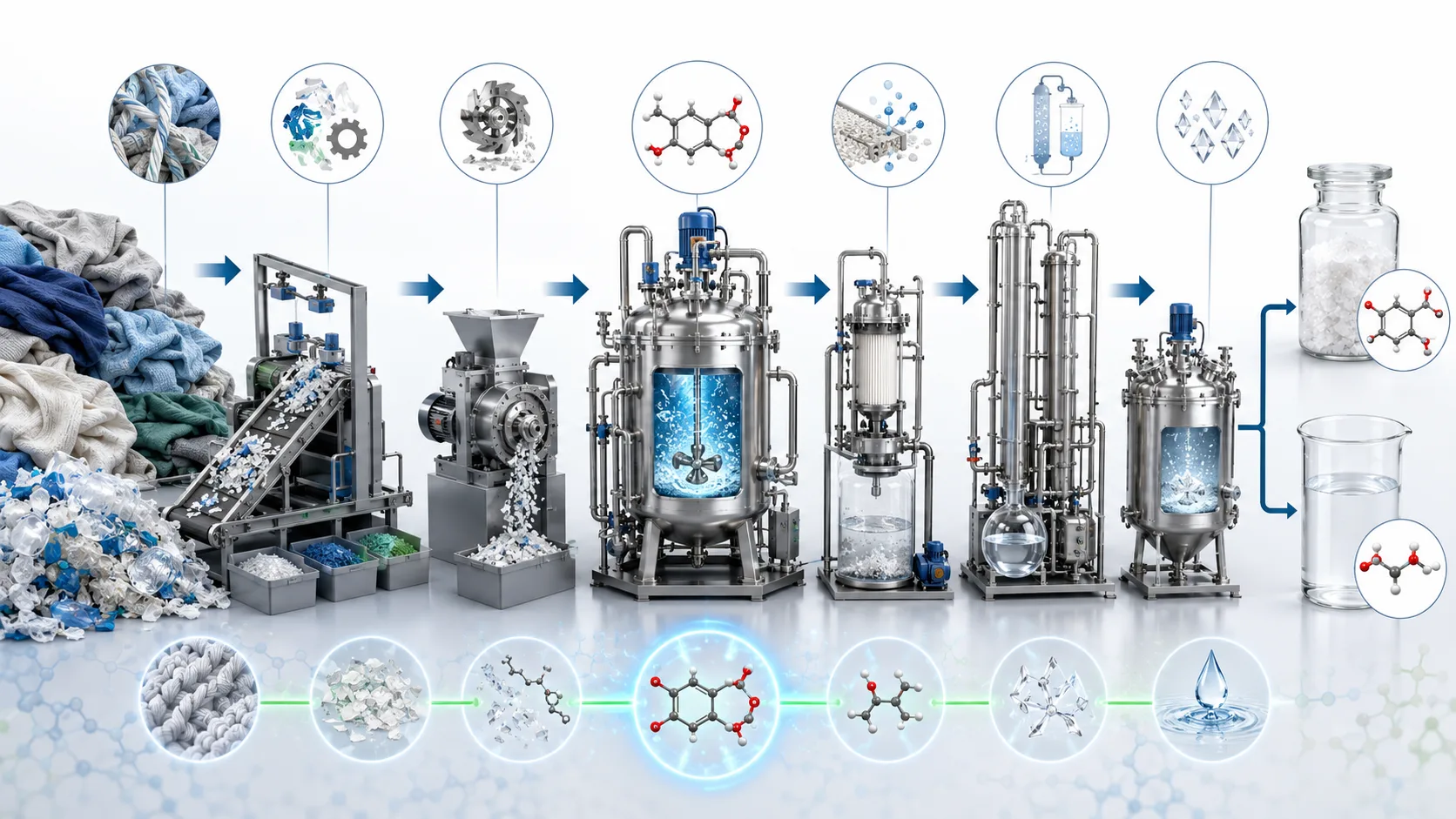
Chemical Recycling of Polyester Fiber Waste: From Waste Polyester to High-Purity DMT and Ethylene Glycol
ResourceCycle explains the four-step chemical recycling process for polyester fiber (polyester textile) waste — pre-treatment, methanolysis depolymerization, DMT and ethylene glycol separation — producing polyester-grade raw materials with purity ≥99.9% from discarded textiles.
Read more 02Technology
Low-Temperature Atmospheric Methanolysis of PET to Polymer-Grade DMT: ResourceCycle's New-Quality-Productivity Process Breakthrough
ResourceCycle and the Zhejiang University Green Carbon Joint Research Center have developed a disruptive process that completes PET chemical depolymerisation at 64.5 °C atmospheric reflux — achieving 99.2% PET conversion, 99.5% DMT selectivity, 99.75% product purity, 60%+ capex reduction, 45-50% energy savings, with kiloton-per-year commercial operation.
Read more 03Technology
ResourceCycle as a Low-Carbon DMT Co-Development Platform for Global Closed-Loop Polyester Partnerships
Global brands are moving material decisions upstream to the polyester monomer level. With high-purity DMT production, methanolysis R&D and closed-loop material platform capabilities, ResourceCycle is positioned for exclusive joint development programs and long-term pre-purchase agreements.
Read more