
DMT Supplier Compliance Review Guide: Hazardous Chemical Management, ISO 14001 and COA/MSDS Documents
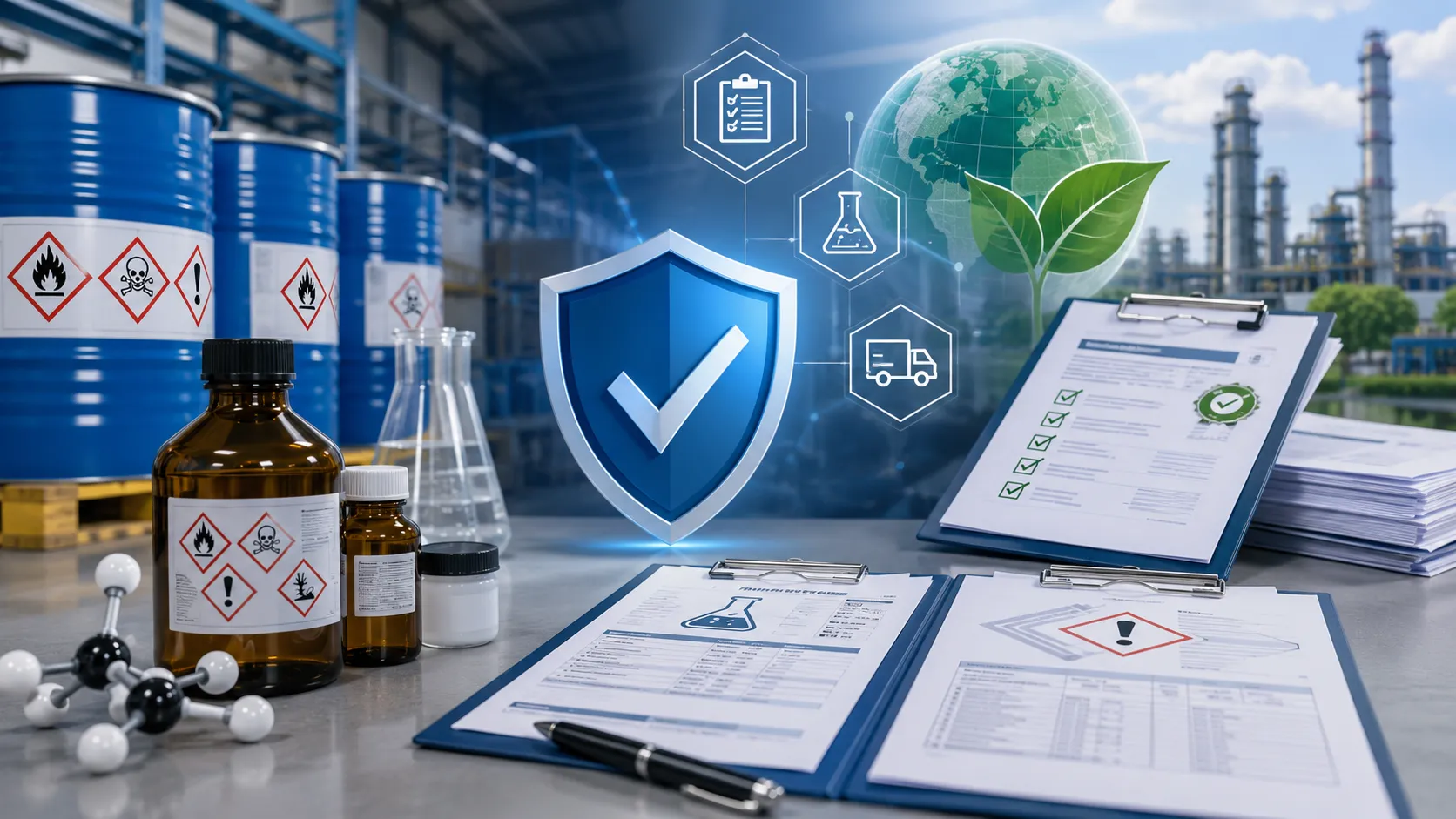
DMT procurement should review not only price and purity, but also supplier compliance, hazardous chemical management, ISO 14001, COA/MSDS documents and batch traceability.
TL;DR
- DMT procurement should review not only price and purity, but also supplier compliance, hazardous chemical management, ISO 14001, COA/MSDS documents and batch traceability.
- Keywords: DMT supplier compliance · ISO 14001 · COA MSDS · hazardous chemical management · batch traceability
Why Supplier Compliance Is a Procurement Risk, Not a Formality
Dimethyl Terephthalate (DMT, CAS 120-61-6) is a chemical raw material, and selecting a supplier on price, purity and lead time alone leaves real exposure. Hazardous-chemical management, environmental compliance, quality documentation and batch traceability all belong in the assessment. A supplier weak on compliance can hand you supply interruption, missing paperwork, a failed customer audit, or an export problem.
What to review during supplier qualification
| Document | What to check | Why it matters |
|---|---|---|
| COA | Purity, acid value, colour, ash, iron content, moisture | Evidence of batch quality stability |
| MSDS | Hazards, storage, transport, emergency response | Supports your own EHS review |
| System certification | ISO 14001, quality and safety management documentation | Reduces long-term partnership risk |
Hazardous chemical management in production and logistics
Producing, storing, handling and transporting chemical feedstock carries a range of EHS obligations. A supplier needs proper warehousing, fire protection, anti-static measures, spill containment and emergency response in place to deliver DMT, ethylene glycol and related chemicals safely.
- Fire, explosion, anti-static and spill-collection facilities per applicable regulation
- Combustible gas alarm systems installed
- Major hazard source declaration where stored quantities exceed threshold
ResourceCycle's Huanggang plant holds Level 2 Work Safety Standardisation certification and operates a documented hazardous chemical management system.
Environmental permitting
- Wastewater: process wastewater treated per the discharge permit and industrial park requirements.
- Air emissions: point-source emissions collected, treated and discharged to standard.
- Solid waste: general and hazardous waste segregated, managed and logged.
How ResourceCycle handles it
The company operates a certified ISO 14001 environmental management system:
- Regular environmental compliance audits
- Proactive communication with regulators
- Environmental impact assessment (EIA) and safety assessment (SA) completed before any new project starts construction
- Every production stage operated inside the applicable legal framework
Procurement advice: when qualifying a DMT supplier, assess sample quality, COA/MSDS documentation, environmental compliance, supply stability and commercial responsiveness together. ResourceCycle can provide the product and supplier documentation your audit process requires.
Frequently Asked Questions
Q1: Is DMT classified as a hazardous chemical, and what credentials are needed?
DMT is not a first-tier hazardous chemical under China's Catalogue of Hazardous Chemicals, though some provinces require general chemical registration. Producers need ISO 9001 / 14001 / 45001 certification, a work safety licence, EIA approval and a discharge permit. Export requires bilingual MSDS and customs HS code 29173600.
Q2: Is ISO 14001 mandatory for a DMT supplier?
Brand green procurement programmes — Coca-Cola, Nike, L'Oréal among them — require ISO 14001 environmental certification upstream. ResourceCycle holds both ISO 14001 and ISO 9001, with complete system documentation available for customer audit.
Q3: Who issues the DMT COA and MSDS?
The COA is issued by the manufacturer's laboratory or a commissioned third-party laboratory, separately for each batch. The MSDS is prepared by the manufacturer per GB/T 16483 and ISO 11014, and updated every three years. ResourceCycle provides both before contract signature.
Q4: What are the key compliance checks when buying DMT?
Business licence and production permit; work safety licence; EIA and discharge permit; ISO 14001 / 9001 / 45001 certificates; complete MSDS and COA; hazardous chemical transport qualification; feedstock and product traceability records; and a clean environmental and safety enforcement record over the last 12 months.
Q5: How do you audit a supplier's batch traceability?
Ask for the per-batch COA, feedstock lot number, production date, process parameter records, raw analytical data, the retained-sample policy and the non-conforming product procedure. ResourceCycle supports both on-site and remote brand-owner audits.
Related Reading
- Dimethyl Terephthalate (DMT, CAS 120-61-6) — specifications, MSDS / COA
- Ethylene Glycol (EG / MEG, CAS 107-21-1) — specifications, MSDS / COA
- Chemical methanolysis DMT process and core technology
- DMT / EG market outlook and brand recycled-plastic commitments
- Policy: chemical recycling as a strategic emerging industry
- Case studies: Zhejiang University joint research centre and the Huanggang project
- Contact sales — DMT quotation, samples, COA requests
About ResourceCycle
Ruisaike (Hangzhou) New Materials Co., Ltd. is a chemical-process manufacturer of DMT and ethylene glycol. Annual capacity is 5,000 tonnes of DMT plus 1,600 tonnes of ethylene glycol, at purity ≥99.9% — meeting polyester-grade virgin material standards. The company operates a joint research centre with Zhejiang University, holds 12 core patents, and is certified to ISO 14001 and ISO 9001. Products serve PBT, PETG, PCTG, PET resin, polyester fibre, polyester coatings, automotive antifreeze and unsaturated polyester resin. Domestic road freight and sea export are both supported (EXW / FOB / CIF / DAP), with a 1-tonne minimum order, 7–30 day lead times, custom COA, sample requests and ESG documentation support.
Related articles
 01Industry Trends
DMT Procurement Guide: How to Choose Solid Flake, Briquette and Liquid Dimethyl Terephthalate
Compare DMT solid flake, briquette and liquid forms across packaging, transport, feeding, storage and downstream applications to support procurement decisions for PBT, PET and PETG customers.
Read more- 02Industry Trends
DMT Supplier Compliance Review Guide: Hazardous Chemical Management, ISO 14001 and COA/MSDS Documents
DMT procurement should review not only price and purity, but also supplier compliance, hazardous chemical management, ISO 14001, COA/MSDS documents and batch traceability.
Read more  03Industry Trends
Recycled Materials Policy Drives Low-Carbon Polyester Raw Materials: Opportunities for DMT Suppliers
China's policy support for recycled materials and low-carbon industries creates long-term opportunities for low-carbon DMT, polyester-grade Dimethyl Terephthalate and high-quality polyester raw material supply chains.
Read more